
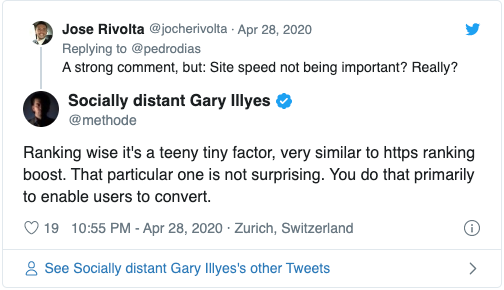
Page speed matters, but it is often the most measurable problem—not the most important one. A business can spend weeks chasing a perfect performance score while the page still attracts the wrong visitors, explains the offer badly, or loses every qualified prospect.
Google uses Core Web Vitals and other page-experience signals, but it also states that good scores do not guarantee top rankings. Performance supports search and conversion; it does not replace relevance, usefulness, trust, or a working customer journey.
Ask what is actually failing
Before approving an optimization project, identify the symptom:
- Is organic visibility declining?
- Are users abandoning before the page becomes usable?
- Are paid clicks expensive and unproductive?
- Are forms, checkout, booking, or navigation failing?
- Is the problem limited to mobile users, a location, a template, or a device?
- Is the site fast in tests but slow for real customers?
Different symptoms require different evidence. A single Lighthouse screenshot cannot diagnose the business.
Lab scores and field experience are not the same
Lab tools simulate a visit under defined conditions and are excellent for finding technical opportunities. Field data reflects how real eligible users experienced pages over time. Analytics adds behavior and business context. Server monitoring can reveal outages and backend delays.
Use them together:
- PageSpeed Insights / Lighthouse: technical diagnosis in a controlled test.
- Core Web Vitals field data: aggregate real-user experience where sufficient data exists.
- Analytics: landing-page behavior, devices, conversions, and traffic quality.
- Search Console: search visibility and page-experience reporting.
- Server and application monitoring: intermittent errors, slow queries, cache misses, and third-party failures.
When speed is probably the real problem
Prioritize performance when users wait before meaningful content appears, buttons move during interaction, clicks respond slowly, checkout or forms stall, mobile performance is materially worse, or revenue and conversion losses align with slow templates or outages.
Also act when a technical regression follows a theme change, plugin update, tracking script, advertising tag, video embed, personalization tool, or hosting problem.
When speed is probably not the primary constraint
A faster page will not solve:
- weak or generic positioning;
- an offer that does not match the search intent;
- low-quality or irrelevant traffic;
- missing proof and unclear pricing;
- a confusing conversion path;
- poor sales response after the form is submitted;
- incorrect analytics or attribution;
- a business profile or advertisement that promises something the landing page does not deliver.
If the page already becomes usable quickly for the target audience, investigate these problems before paying for diminishing technical gains.
A better prioritization method
- Segment the evidence. Compare landing pages, devices, countries, browsers, traffic sources, and conversion events.
- Find the affected journey. Identify where delay or instability prevents a customer action.
- Estimate business impact. Combine traffic, conversion value, failure rate, and implementation cost.
- Fix the cause, not the score. Remove or defer unnecessary work, optimize critical assets, correct backend bottlenecks, and test third-party scripts.
- Measure after release. Confirm real-user improvement and the expected change in business behavior.
Performance is an engineering decision with a business priority
A perfect score can be disproportionately expensive, temporary, and invisible to customers. A targeted improvement to the slowest revenue-producing journey can be extremely valuable. The goal is not to make a tool green. It is to remove friction that prevents the intended result.
If the development team, SEO agency, and marketing team all report that their part is correct while the site still underperforms, the missing step is an independent diagnosis across the whole journey.
Google’s current reference: Understanding page experience in Google Search results.
Request a Digital Performance Investigation to determine whether speed is the constraint—or merely the most visible metric.