
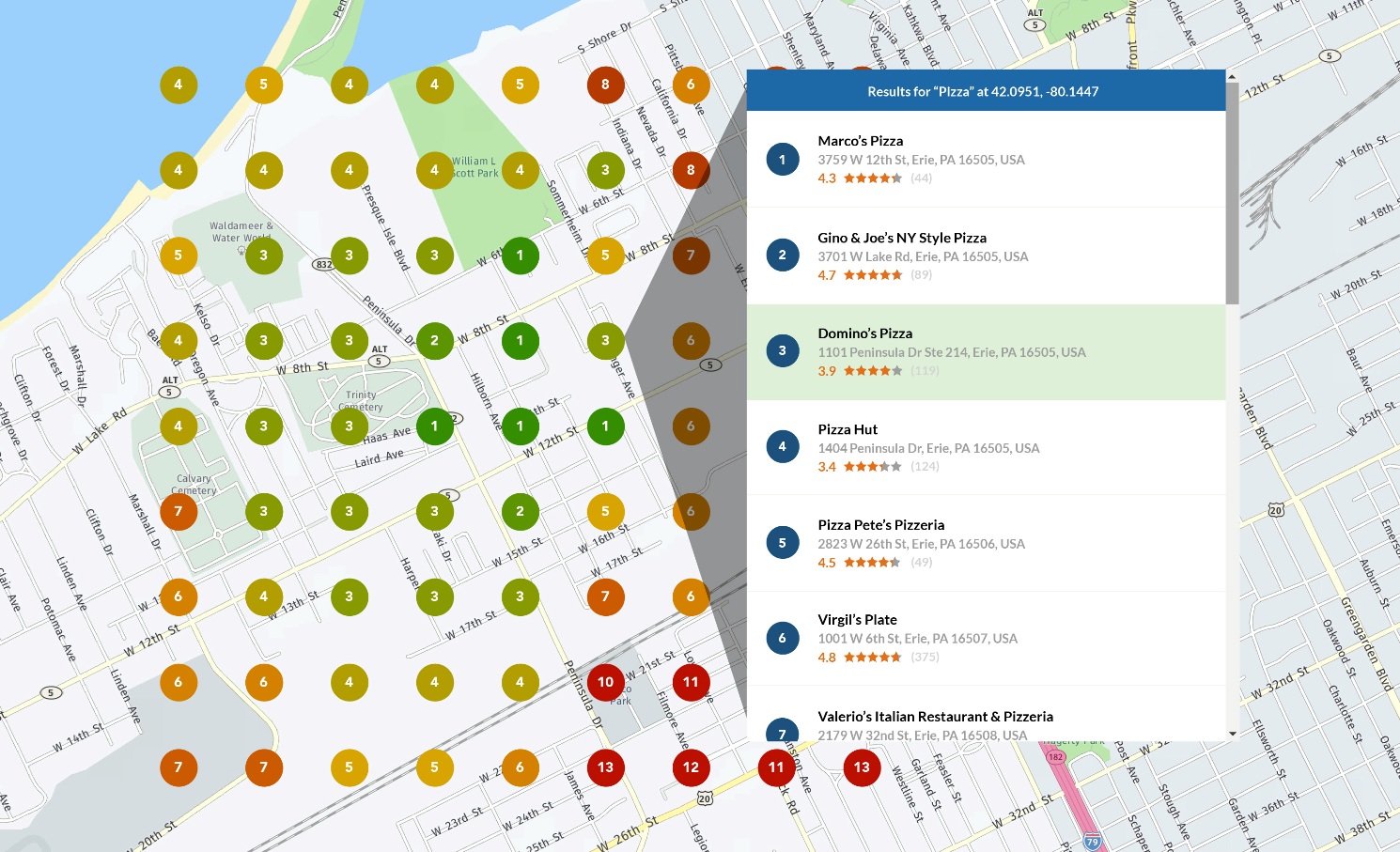
There is no single Google result for your business. Search results can change with the user’s location, query wording, device, language, search history, time, and the type of result Google chooses to show.
That makes “I checked and we are number three” weak evidence. A useful local-visibility audit tests representative customer situations, records the search surface, and connects visibility with qualified actions.
Start with locations that matter commercially
Do not test every possible postcode. Build a location set from the business reality:
- the address and immediate neighborhood;
- priority service areas;
- high-value towns or districts;
- boundaries where visibility appears to drop;
- competitor strongholds;
- areas that generate good customers versus poor-fit inquiries.
For multi-location companies, treat each location as a separate operating entity before comparing the brand as a whole.
Test more than the company name
Branded visibility confirms that Google can find the business. It does not show whether new customers discover it. Test query groups such as:
- service + city or neighborhood;
- urgent or “near me” needs;
- category and specialty terms;
- comparison, price, availability, and opening-hours questions;
- problem-led queries used before the customer knows the solution;
- brand variations, old names, and common misspellings.
Record the search surface
A traditional organic result, local pack, Google Maps result, advertisement, product result, video, marketplace, and AI-generated answer are different opportunities. Record which surface appears and which business assets it uses.
For each test, capture:
- query and simulated or actual location;
- date, device, and language;
- the business position or absence;
- the competitors shown;
- rating, review count, category, hours, and key attributes;
- the landing page or profile action;
- obvious wrong or conflicting information.
Use the right testing method
Manual checks are useful for seeing the real result layout, but they are difficult to reproduce at scale. Location-grid rank trackers can reveal patterns around a map. Advertising preview tools help inspect some search situations without creating live ad impressions. Search Console shows real queries and broad geographic performance, though it is not a precise local-rank tracker.
A VPN changes network location but does not guarantee a clean or exact local simulation. Incognito mode reduces some personalization but does not remove location and other context. Treat every method as evidence with limitations.
Investigate why visibility changes
Local visibility can be influenced by relevance, distance, prominence, category selection, profile completeness, reviews, links, citations, on-site location information, local competition, and the wording of the query. No single factor explains every grid.
Common system failures include:
- one page trying to rank for many genuinely different locations;
- duplicate or outdated business profiles;
- service areas that do not match operational capacity;
- different names, categories, phone numbers, or hours across platforms;
- location pages with no unique value or proof;
- strong map visibility that leads to the wrong phone, menu, booking link, or website page;
- marketing targeting areas the sales or service team cannot handle profitably.
Connect the map with business outcomes
Track calls, direction requests, bookings, website actions, qualified leads, and revenue by location where feasible. Compare this evidence with staffing, capacity, margins, and customer quality.
A weak rank in a low-value area may not deserve investment. A small visibility gap around a profitable service zone may be urgent. Prioritization should follow the business opportunity, not the prettiest heatmap.
A repeatable local-visibility investigation
- Define valuable customers, services, and geographic boundaries.
- Create a stable query-and-location test set.
- Record maps, organic, paid, marketplace, and AI surfaces.
- Audit profiles, website pages, citations, reviews, and conversion links.
- Compare competitors and identify the evidence they provide.
- Fix the highest-impact inconsistency or missing asset.
- Retest under the same conditions and measure downstream actions.
Request a Digital Performance Investigation when local rankings, profiles, website data, and actual sales territories do not tell the same story.